
Blog
How Prank-Based Storytelling Works in Games and Webcomics

Pranks and entertainment are inseparable. We aren’t talking about the loud ones that are in-your-face. But about those subtler, playful pranks that make the story so exciting to follow. The moments that seem harmless at first… until they’re not. In games and webcomics, that kind of surprise has become a powerful storytelling tool. It pulls people in fast and keeps them guessing. It also turns everyday situations into moments people actually remember.
Think about a game level that feels safe, and then suddenly isn’t. Or a story beat that starts as a joke and slowly spirals. That’s prank-based storytelling at work. In this article, we’ll look at how that approach functions across games and webcomics, using Prank Goes Wrong as a case study – and why this style fits modern digital entertainment so well.
Core Idea Behind Prank-Based Stories
Strip it down, and prank-based storytelling is pretty simple. First, we create an expectation and then break it most excitingly. The readers think they know what happens next, but the plot suddenly takes an unexpected, often humorous, turn.
In games, this could mean that a totally ordinary action leads to an unexpected, often hilarious outcome. Some games use pranks as the basis of gameplay and plot. The trick is restraint. The surprise should be well-managed and not chaotic. It should be thrilling, but in line with the whole story.
Prank Goes Wrong Honeytoon webcomic, uses this technique as the central premise, making the characters, as well as the readers, thrilled to see what happens next. It works because it feels real. And that’s something that will encourage the audience to keep on reading.
Why Pranks Work So Well in Games and Webcomics
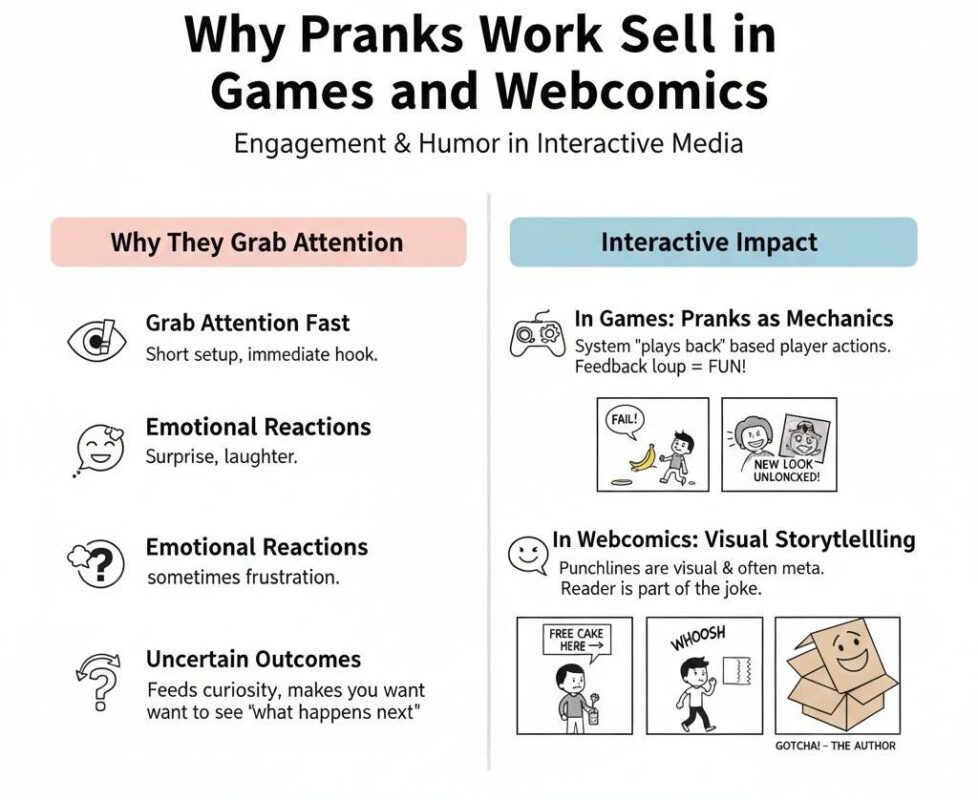
Before jumping into the comic itself, let’s look at pranks in general. Why do they work so well in interactive media?
A few reasons stand out right away:
- They grab attention fast without a long setup
- They create emotional reactions, not just passive viewing
- They keep outcomes uncertain, which feeds curiosity
In games, especially, pranks often double as mechanics. The joke isn’t only in the dialogue. It’s in how the system responds to what the player does. The game “plays back,” and that feedback is where the fun lives.
Prank Goes Wrong as a Case Study
Prank Goes Wrong makes excellent use of this structure. At its very beginning, we dive headfirst into unexpected choices made by protagonists. Their surprising decisions turn a casual prank into something else entirely.
What makes the story work isn’t the prank itself, but the aftermath. All the pressure and misunderstandings that follow. Those interpersonal interactions make the story so thrilling and reveal more about the characters than any other situation ever could.
Some of the elements the comic uses to engage the readers:
- How characters react under pressure
- Pacing: it’s fast, but not overwhelming
- The shocking difference between what was expected and the outcome
We both love and hate pranks in real life for the same reasons – the surprise and the reaction that follows. According to statistics, 45% of US adults find pranks amusing, while 47% think they’re actually annoying. What this study shows is that no one is immune to pranks, and they always grab people’s attention.
Escalation Is Where the Story Lives
Here’s the thing: good prank-based storytelling isn’t really about the prank. It’s about what happens after. In Prank Goes Wrong, escalation happens step by step. As the main characters, Jerry and his stepsister, Laura, unknowingly get into a situation they can’t control, the story builds up excitement with each episode. And yet, the plot unfolds in such a way that the readers aren’t overwhelmed. They’re carried forward.
Games use the same rhythm. The player feels clever at first and entirely in control. Then the realization hits – something bigger has been triggered. That slow shift from confidence to uncertainty is what keeps people locked in. It’s a quiet kind of tension, and it works wonders for the story and gameplay.
How Games Use Humor and Pranks to Tell Stories
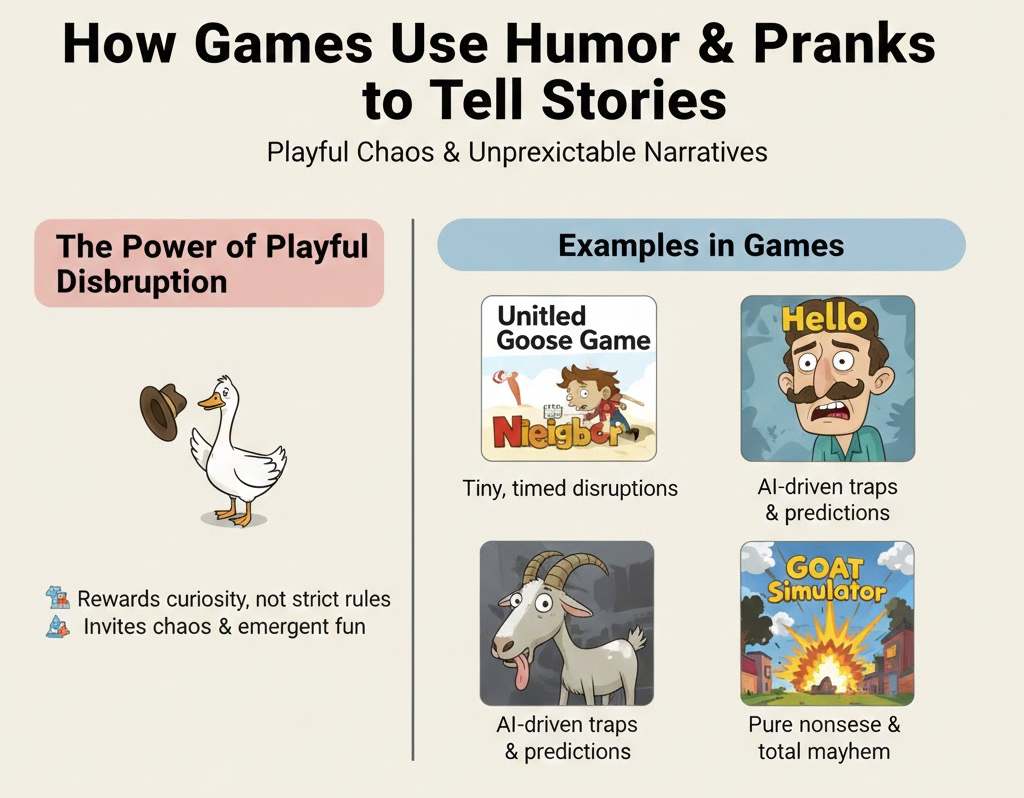
A lot of games lean into prank-style storytelling, especially the ones that don’t want you to follow the rules too closely. These are the games that reward curiosity. Instead of guiding players down a neat, predictable path, they invite a bit of chaos – sometimes even encourage it.
- Untitled Goose Game looks almost too simple. There’s a checklist, a quiet village – nothing fancy. But once you start playing, those basic tasks turn into a string of tiny, perfectly timed disruptions.
- Hello Neighbor goes in the opposite direction. It may seem relatively calm at first, but the AI tools help the game learn the player’s habits, so pretty soon, all their steps get predicted, making it harder to play the game.
- Goat Simulator doesn’t even try to act serious. It knows exactly what it is. Pure nonsense and total mayhem. The fun comes from the fact that absolutely anything can go wrong – and usually does.
Mobile mini-games do this too. Some levels “lie” to the player. Others flip rules at the last second. Those moments stick because they interrupt routine.
Just like in Prank Goes Wrong, the humor isn’t about being mean. It’s about losing control – briefly – and seeing what happens next.
Why This Style Fits Mobile Audiences So Well
Prank-driven stories are especially compelling on mobile. No mystery there. Mobile readers and players engage in short bursts. A quick setup, a twist, and a pause. That rhythm fits perfectly with prank-based storytelling.
Prank Goes Wrong is structured so readers can jump in, experience a moment of tension or humor, then step away – while still wanting to come back. That same loop drives casual games and mobile mini-games every day. They’re short, punchy, and memorable.
Conclusion
Because it appeals to something really human – unpredictability – prank-based storytelling is incredibly compelling. Pranks produce intimate, tense, and unexpectedly humorous moments in both games and webcomics. Prank Goes Wrong demonstrates how a straightforward concept may develop into an engaging story when individuals respond honestly, and consequences are taken seriously.
The story fits in well with how contemporary audiences consume digital material since it emphasizes escalation rather than shock. As games and webcomics continue to influence each other, prank-driven narratives aren’t going anywhere. They’re too relatable – and too effective – to ignore.