
Blog
How Three WoW Midnight Raids Affect the Progression
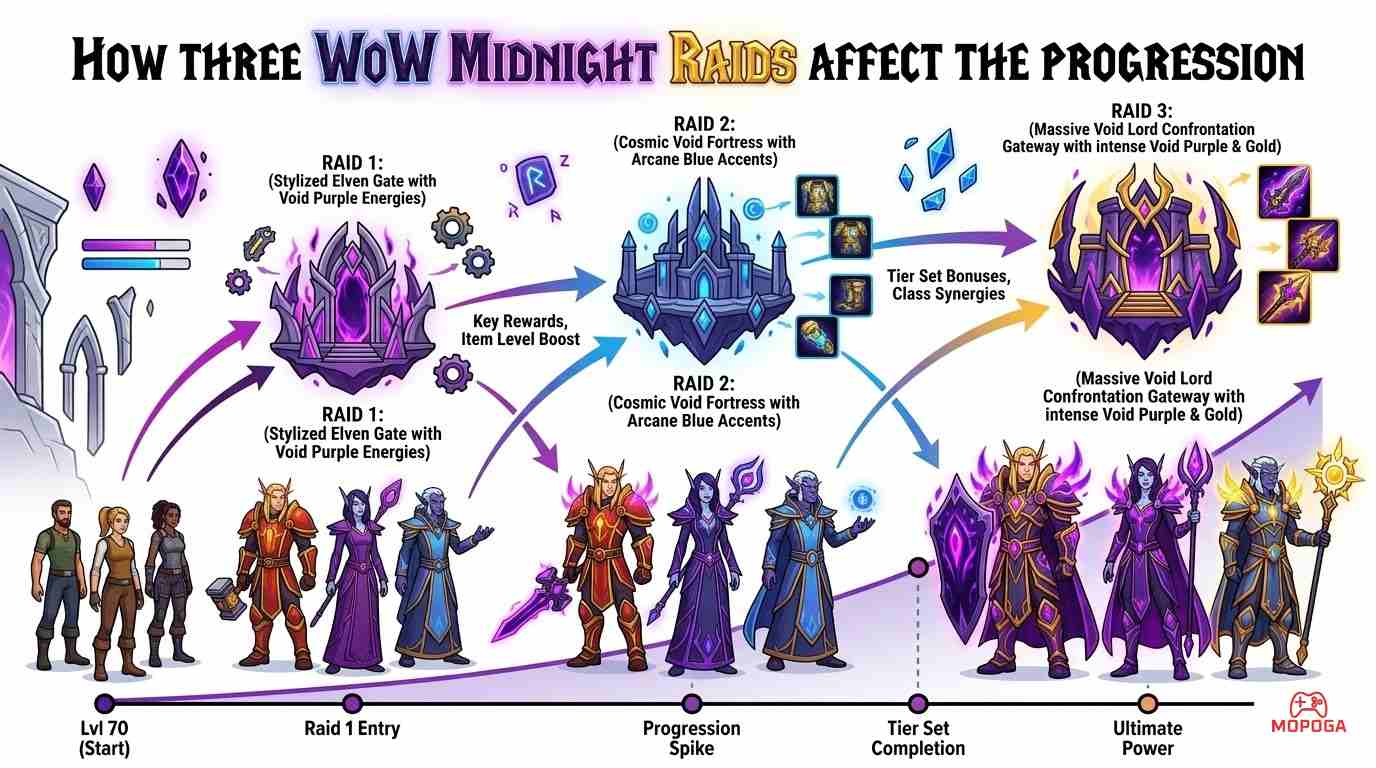
World of Warcraft does not normally kick off a season with this much raid content packed into such a brief period of time. In Midnight Season 1, Blizzard is introducing three different raids in a few weeks: Voidspire, Dreamrift, and March on Quel’Danas. The more important takeaway, though, is what this structure does to normal WoW habits: roster planning gets tighter, alt gearing becomes more valuable, and players who normally split time between raids, Mythic+, PvP, and farming have to choose their priorities faster than usual.
This is why the topic is not just important for a single expansion. Even though we speak mostly of Midnight, the actual question is what happens when WoW compresses progression pressure and asks players to keep up with several endgame roads at once? That is where raid planning, guild logistics, and even a World of Warcraft boost or coaching service come into play. Not because every player needs outside help, but because time pressure always alters the value of convenience to people.
WoW Midnight Raids Basics
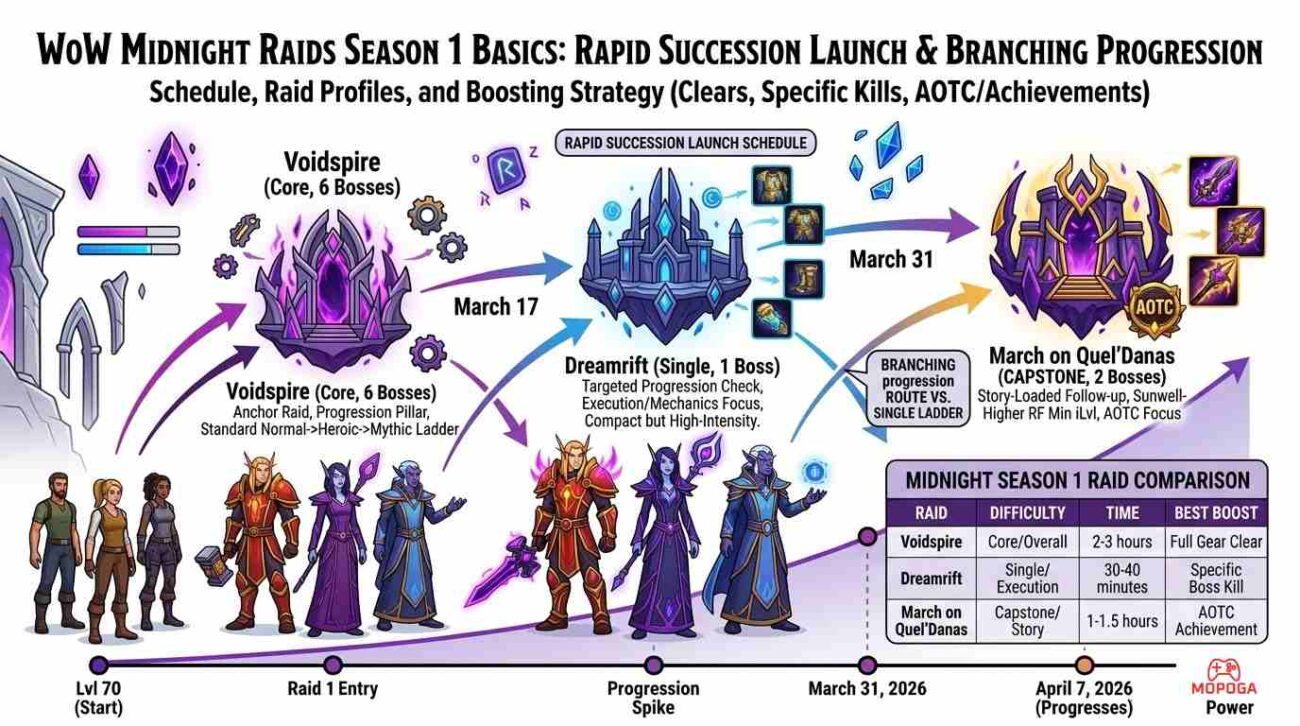
It is more accurate to say that Midnight raids are launching out in rapid succession rather than “simultaneously.” The official schedule has Voidspire and Dreamrift opening in the week of March 17, 2026, while on March 31, March on Quel’Danas follows, and its Raid Finder and Story Mode open on April 7. Voidspire is the huge anchor raid with 6 bosses, Dreamrift being a 1-boss fight, and March on Quel’Danas being a 2-boss follow-up raid that is closely connected to the storyline of the Sunwell.
Altogether, that makes Midnight Season 1 nine raid bosses scattered throughout three raid zones. That is not a typical setup for modern WoW, and just because of that, people are discussing it. A six-boss core raid already calls for the normal cycle of progression from Normal into Heroic and then Mythic for serious groups. Add in a one-boss side-raid and story-heavy two-boss follow-up, and suddenly the season doesn’t feel at all like a single ladder, but more like a branching route.
For guilds, that is exciting. For pugs, it can get messy. For players with only a couple of nights a week, this often turns into the classic need for a WoW Midnight boost, selective carries, or coaching to avoid dead time and pay attention to what they actually want from the game: rewards, PvP, roleplay, etc.
| Feature | Voidspire (Core) | Dreamrift (Single) | March on Quel’Danas |
| Difficulty Focus | Overall progression | Execution / Boss mechanics | Story & High-end loot |
| Time Investment | 2-3 hours | 30-40 minutes | 1-1.5 hours |
| Best Boost Type | Full Gear Run | Specific Boss Kill | AOTC / Achievement |
Three Midnight Raids Basics
- Voidspire is the progression pillar. It has six bosses, opens first, and obviously serves as the backbone of the tier. If you have a guild that is testing the strength of raids, this is where most of that will take place.
- Dreamrift is the opposite, a one-boss raid that appears to be compact on paper. Still, one-boss raids in WoW often become a targeted progression check since the entire instance is concentrated in a single encounter.
- March on Quel’Danas comes later, appearing to be the story-loaded capstone, with a higher Raid Finder minimum item level than the other two raids.
This variety is, in fact, beneficial to the game. It breaks up the one big raid, followed by farming it for months on end. It also causes different service demands. Some players are interested in having a full clear. Others want the achievement for the toughest bosses. There are also player who do not want a Midnight boost for the entire tier at all; they simply want a specific kill, an AOTC achievement, or to learn the fights before pugging them later on their own.
How WoW Players Keep Up With Midnight Raids
For the top-end guilds, Midnight looks like a progression puzzle. For everyone else, it is more of a time management issue. That is why this topic is more important for everyone, rather than just Mythic raiders. Most players do not want the world rankings. They are trying to be raid-ready, and at the same time, doing Mythic+, helping fill the Great Vault, helping cap PvP, helping friends with alt runs, etc. In pulling three raid targets open nearly back-to-back, that pressure is more significant to regular players than it is to elite groups.
As a result, more people begin to look at Heroic clears, AOTC runs, and a World of Warcraft carry for a boss that drops the item they still need. For players weighing up the options in the latter case, the best WoW boost service is a natural choice, as the real intent is often not to cheat the game, but to save time and keep the progression going.
Midnight also alters the feeling of raid prep. The developers are pushing the game towards less addon automation and more powerful in-game UI tools, such as clearer warnings about bosses, visible key casts, and raid frame support. In practice, that will mean awareness and execution will be more important, especially for groups that used to rely heavily on addon-driven callouts.
The larger point is rather simple: when WoW increases coordination demands, players usually respond in 3 ways. They spend more time, have lower goals, or spend on the WoW boost service to make the season more manageable.
How to Choose a Raid Carry in WoW
All things considered, many WoW players eventually chose to seek help from the outside. When selecting a raid carry in WoW, price shouldn’t be the only thing that you look at. A lower-priced offer can still be a bad deal if there is no clear explanation of what is included, how long the run should take, if it is self-play or played by a pilot, and what happens if the group is delayed.
Here are the main criteria worth checking before you choose a run:
- Raid format: full clear, specific bosses, Heroic, or Mythic;
- Run type: self-play or piloted;
- Loot rules: whether loot trading is possible and what is actually included.
- Estimated duration: how long the run usually takes.
- Schedule and start time: fixed raid time or flexible booking;
- Support quality: how fast the team responds if something changes.
- Requirements: item level, character readiness, or account conditions;
- Provider reputation: how clearly the service is presented and organized.
The best way to compare a WoW carry is to look at the clarity first. A good offer should clearly explain the raid format, boss coverage, loot rules, and support process, using concise and unambiguous language. That is even more important during busy times of the year, such as the Midnight, when players are looking for a quick and reliable method to track raid progression.
It is also helpful to check the type of provider. Marketplace listings usually have low prices, but there can be much variation in quality. Community groups may feel more personal, but communication is not consistent. Store-bought platforms generally provide a cleaner platform, which facilitates the comparison of various WoW boosting services and makes the selection process easier, as per your goals.
In the end, the right raid carry is the one that saves time without causing additional confusion. Good WoW boost services should be transparent, organized, and focused on the real WoW progression instead of the flashy promises.
Best Ways to Carry Raids in Midnight
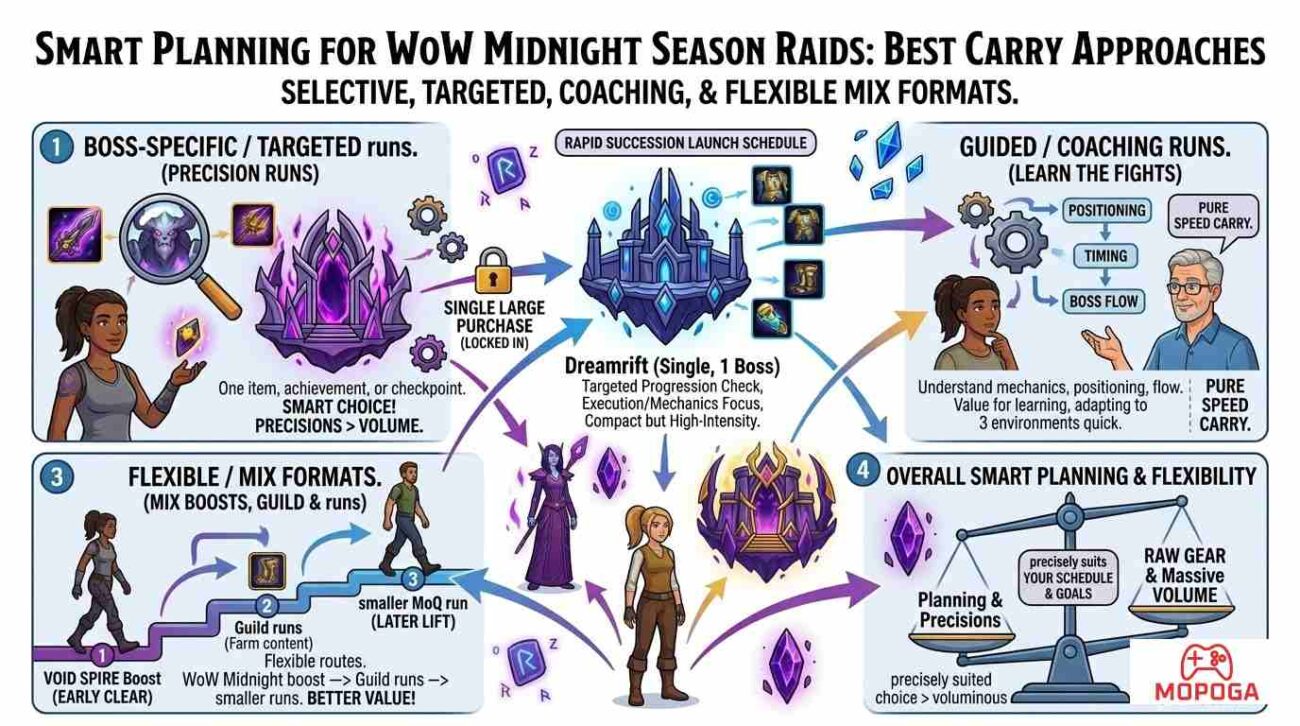
The best way to approach raid carries in Midnight is based on what you actually need from the season. Some players want a total clear to be able to keep up with the opening rush. Others only care about one tough boss, an achievement, or a quicker path to gear before returning to Mythic+ or PvP. Since Voidspire, Dreamrift, and March on Quel’Danas are landing so close to each other, targeted runs will often make more sense instead of buying everything at once.
For a majority of players, a selective carry is the best choice and not the biggest package on the page. A full raid clear is good if you intend to have broad progression and easy access to multiple rewards. However, a boss-specific run is the smarter choice if you are going after one item, one achievement, or one progression checkpoint. In a stuffed season like this, it is more important to be precise than it is to be voluminous.
Coaching style runs are also worth more than most players think. A standard WoW carry will get you through the content quicker, but if you run a guided run, you can also be shown positioning, timings, and boss flow whilst the fights are still fresh. That is even more significant in Midnight, where players will be adapting to three raid environments over a short span of time instead of farming one place for weeks.
Another good route is being a mix of formats rather than having one solution.
For example, you can do a WoW Midnight boost for an early clear in Voidspire, then switch to guild runs for farm content, and as a later option, book a smaller run for March on Quel’Danas once it opens. That flexibility will typically provide you with better value rather than locking yourself into a single large purchase, which you might not necessarily need.
In other words, the best raid carry in Midnight is not necessarily the fastest or the biggest raid carry. It is the one that suits your schedule, your goals, and the part of progression where you are actually stuck. With three raids opening up almost back-to-back, smart planning will be just as salient as raw gear.
Disclaimer
This article is intended for informational and educational purposes only. All references to World of Warcraft, its expansions, raids, and in-game systems are the property of Blizzard Entertainment. The discussion of raid carries, boosts, or coaching services is provided as general information about player options and community practices within the game.
The author and publisher are not affiliated with, endorsed by, or sponsored by Blizzard Entertainment. Players should always review the official game policies and terms of service before purchasing or using any third-party services.