
Blog
Shared vs VPS vs Dedicated Hosting: A Clear Comparison for Non-Technical Users
When faced with selecting a suitable hosting plan, most small business operators feel unsure about the process, and rightly so. Providers introduce industry jargon like ‘dedicated servers’, `shared hosting’, `VPS’, and many others to describe services, leaving operators to figure out what it all means. However, importantly for all business operators, hosting choices directly influence the speed, reliability, and growth potential of a business website.
Business operators in the USA, UK, Canada, UAE, Turkey, Brazil, and Russia are learning to understand the practical side of hosting rather than the technical side. As such, many want to understand the hosting services offered by business solutions providers like Ultahost .
Most non-technical users who are unsure which service to pick face several comparisons.
Why Hosting Type Matters
When a hosting service provider talks about hosting, they are referring to how they can make your website available on the Internet. Hosting services all present your site similarly, but the way they do so behind the scenes can differ from one provider to another.
Consider how active your site is, the importance of uptime to your business, and the level of leeway you require as you expand. Selecting an option that is too small may lead to performance problems.
Shared Hosting
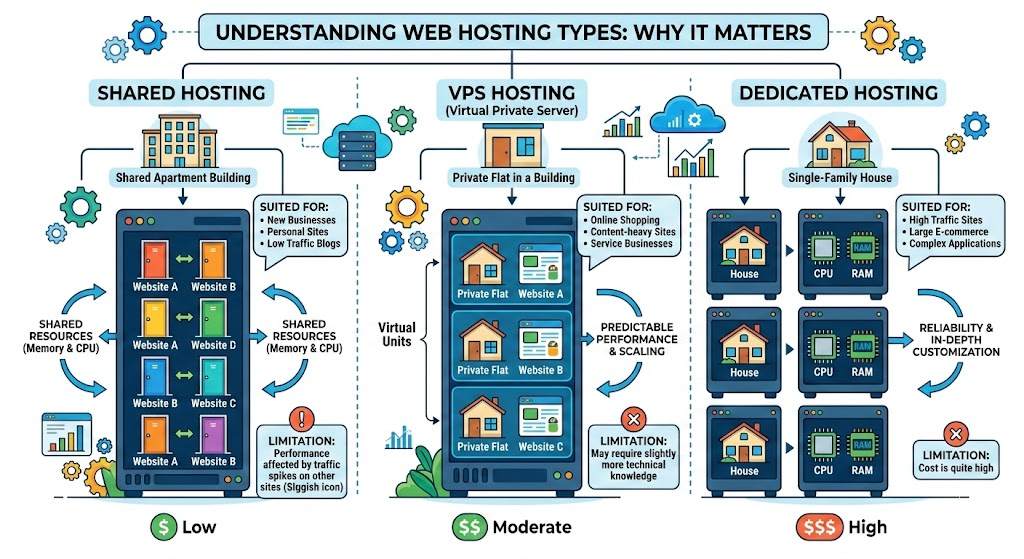
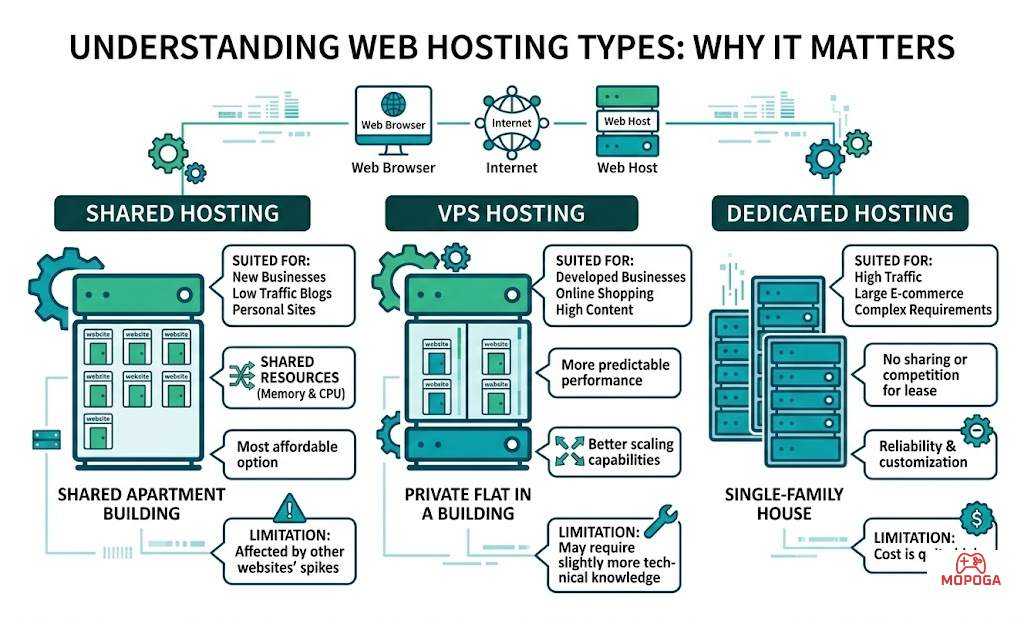
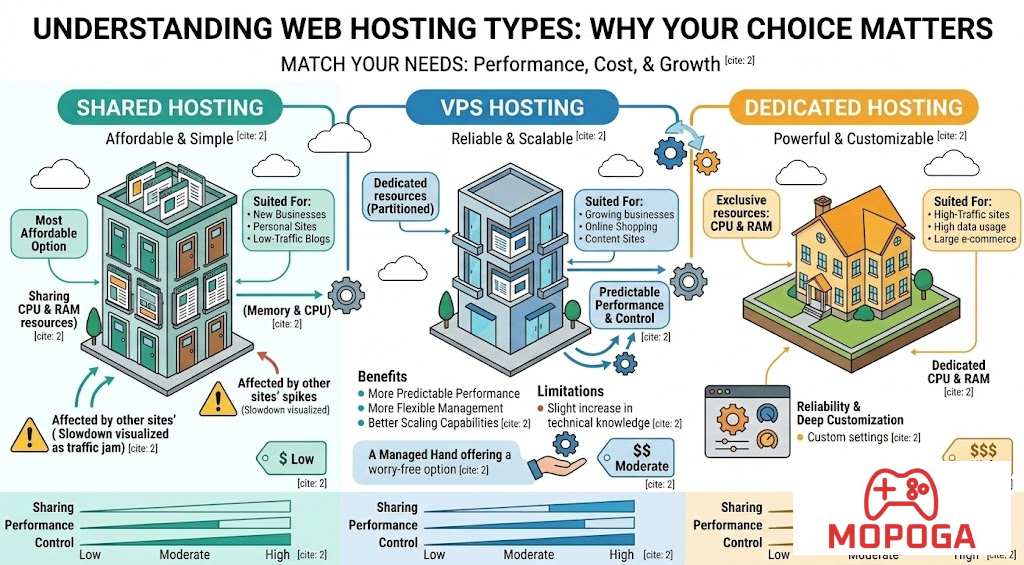
Shared Hosting is usually the first type of package businesses end up with. As its name suggests, your website will be hosted on a server with many other websites. All these websites will be sharing the same resources( memory and CPU).
This kind of Hosting is suited for:
- New business venture
- Personal and informational website
- Blogs with low/moderate traffic
- Small website with basic functionality
Since all websites share the costs, this form of Hosting is usually the most affordable. For starting a business and going online for the first time, especially when using a tool such as an AI Website Builder to get started quickly, shared Hosting has proven to be an enabling platform.
Limitations:
However, this form of Hosting is said to be affected by what other websites are doing. If one of the websites hosting this server experiences a traffic spike or a sudden server failure, other websites are likely to slow down.
For a business where the website is part of day-to-day operations, shared Hosting may eventually prove restrictive.
VPS Hosting
VPS stands for a ‘Virtual Private Server. Each website will still be hosted on the same server, but will have its own set of resources in its own environment. Think of VPS hosting as moving out of the shared apartment into your own private flat, in the same building!
People move to VPS hosting because it provides:
- More predictable performance.
- More flexible management and control.
- Better scaling capabilities in response to an increase in traffic.
- As compared to shared Hosting, VPS provides a more reliable environment.
For more developed business websites than the simplest-read; online shopping, service services and websites with a lot of content, VPS hosting offers room to develop without the expense of a dedicated server.
Limitations:
The drawback of VPS hosting, in some situations, is a slight increase in the technical knowledge required, though many companies choose managed VPS hosting and avoid acquiring computer skills.
Dedicated Hosting
What dedicated Hosting offers is a whole computer/server for us, with no sharing or competition for lease! Best suited to people with very high volume, complex applications or demanding requirements.
Dedicated Hosting is normally selected by:
- High traffic websites
- High data usage companies
- Large e-commerce platforms.
- Companies with complex customer requirements.
Rather than speed, dedicated servers are reliable, and customization options are in-depth.
Limitations:
Cost is quite high, though, as with most things, the more computing power required to do a job, the more expensive it becomes. For many small companies, this is a needless expense until a certain size is reached.
Performance
From the Customer’s view, Hosting affects: The speed at which pages are viewed, Website response time, and stability during busy periods.
While shared Hosting performs well during normal loading times, it can slow down significantly when traffic rises. VPS hosting handles such increased demand more easily; another reliable option is dedicated hosting, which delivers consistent performance.
Given the very competitive nature of several markets (US/UK) where rapid access to information is wanted, even to observe any speed differences from one Hosting to another, it will be clear; sites will perform faster, and hence their competitors will collapse faster (no matter to whom it does or does not matter); in booming markets like: Turkey, Brazil, or the United Arab Emirates, will be count on the using of performance of the website.
Cost vs Value
Shared Hosting is the cheapest, but also the most constrained. VPS hosting costs more and provides better performance and scalability. Dedicated hosting costs even more, but provides the most flexibility and control.
The trick is finding services that align with the impact on your business. For example, saving a couple of dollars on Hosting may seem wise until your site crashes, taking your entire new business with it.
Scalability and Growth
In the vast majority of businesses, thinking in terms of value rather than just price makes more sense.
The biggest mistake many businesses make is choosing solely based on current needs. Growth often happens unexpectedly.
Shared Hosting is often not scalable and can quickly be outgrown. VPS provides a closer step up, while dedicated Hosting supports the long-term journey, although it may be an overshoot initially. Many startups begin with shared Hosting and move up as traffic rises, turnover increases, and complexity shifts. Hosting should be part of that evolution.
Security
Security responsibilities differ between plans. Shared hosting areas can pose greater risks, while VPS and dedicated hosting offer stronger security isolation.
However, most small businesses expect hosting providers to handle essential security responsibilities automatically, so what really counts is consistency, visibility, and diligent, proactive measures.
Which Hosting Type Is Right for You?
Here is a quick overview to think about it:
- Shared Hosting: Best for small or new sites that do not yet need to handle high traffic.
- VPS Hosting: Good for progressive, medium-sized sites looking for reliable flexibility.
- Dedicated Hosting: Well-suited to large sites with consistently high usage.
The most suitable option for your business is the one that aligns with your current business stage, rather than simply choosing the one with the most features.
Today, many small businesses are not simply choosing a hosting provider; they are choosing a complete website setup experience. This is where an AI website builder can be useful, enabling non-technical users to set up operational websites with robust hosting rapidly.
Which Website-Building Approach Fits Each Hosting Type?
When choosing a hosting plan, it’s equally important to consider how you’ll build and manage your website. Different website-building approaches pair naturally with different hosting environments, depending on your technical skills, customization needs, and growth expectations.
Shared Hosting
Best paired with:
- AI website builders, such as Site.pro
- Simple CMS setups, like WordPress with light themes and limited plugins
Why:
Shared Hosting is optimized for ease and affordability. AI website builders are an excellent fit here because they allow you to launch a functional, attractive site quickly without needing development skills. In most cases, the resource demands are modest, making shared hosting sufficient. Lightweight CMS configurations also work well, provided the site is not plugin-heavy.
Best for: New businesses, service-based companies, personal sites, landing pages, and small portfolios.
VPS Hosting
Best paired with:
- More advanced CMS builds (multi-plugin WordPress setups)
- Custom development projects that need more server control
- AI builders require higher performance when site features expand
Why:
VPS Hosting offers dedicated resources and improved performance, which suit businesses that have outgrown entry-level Hosting. A CMS like WordPress becomes significantly more stable and efficient on a VPS—especially when using resource-intensive themes, ecommerce plugins, or caching systems. Custom-coded sites also benefit from the additional server control and configuration flexibility.
Best for: Growing businesses, mid-sized ecommerce, high-traffic blogs, and sites requiring specialized functionality.
Dedicated Hosting
Best paired with:
- Highly customized development (full-stack, performance-tuned systems)
- Enterprise-grade CMS deployments
- Complex integrations or applications requiring maximum control
Why:
Dedicated Hosting provides the entire server to you alone, which is ideal when performance, security, and customization are top priorities. Custom development projects often require precise server-level adjustments, advanced security controls, or high computing power—requirements that dedicated environments handle best. Large CMS installations, including multisite networks or enterprise content workflows, also benefit from full server capacity.
Best for: Large ecommerce operations, enterprise portals, software platforms, and high-traffic applications.
Final Thoughts
Your Hosting shouldn’t have to be complicated to be effective. Knowing the basic differences between shared, VPS, and dedicated hosting, anyone can make a hosting choice without getting bogged down in technical details.
With websites being so fundamental to a business’s success, hosting options need careful consideration. Taking the time to understand it now will avoid future complications and ensure your website works for your business, rather than against it.