
Blog
Accumulator Culture: How The Weekend Football Coupon Became A British Ritual
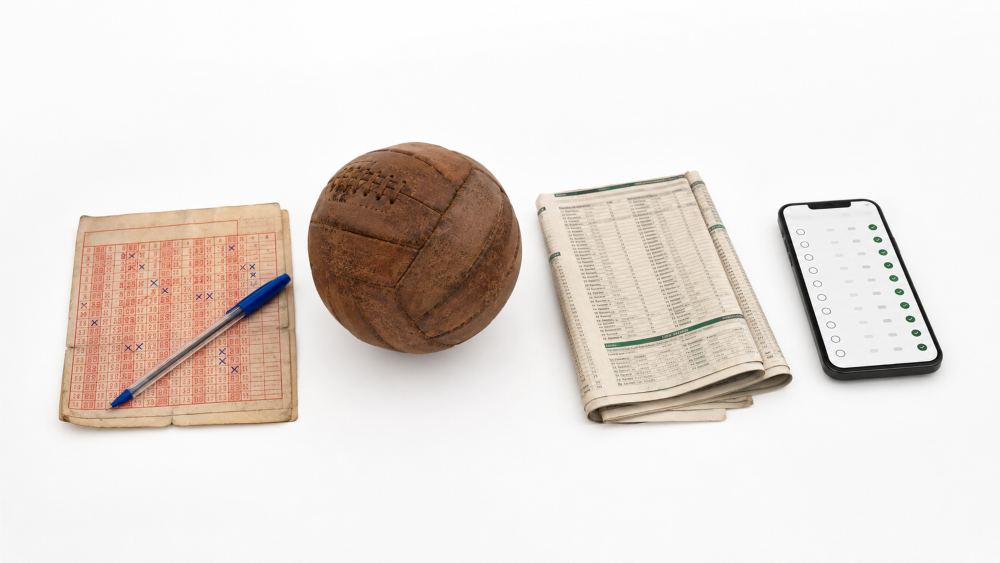
The football coupon was, for most of a century, a piece of paper you had to hold still.
It arrived folded. The fixtures ran in columns printed so tightly that the away side bled into the home side, and every line demanded a decision before the week ran out. Nobody in 1955 described it as entertainment. It was simply the thing you did between one Saturday and the next, somewhere between the ironing and the shipping forecast.
The accumulator inherited that job. The paper has gone, the biro has gone, and the Friday evening pause over the last selection has stubbornly refused to go anywhere at all.
A Century Of Marking Boxes
Britain’s coupon habit did not begin as a national institution. It began as a small, semi-legal print job.
Littlewoods started handing out pools coupons outside a Manchester ground in 1923, and the response was so thin that the first batch barely sold. What followed is the interesting part. Within three years, the operation had grown enough to attract anti-betting campaigners and the police, and prosecutors argued that printing the coupons was itself unlawful. That detail sits in the Littlewoods heritage archive, and it explains something about the culture that grew afterwards: the pools became mainstream faster than the law could decide what they were.
By the mid-1930s, contemporary press estimates put weekly pools spending in the region of twenty million pounds across roughly ten million players. That scale created a strange side effect. The clubs producing the fixtures were often broke while the companies printing the coupons were not, and the resulting argument over who actually owned a fixture list ran for decades before reaching the courts. The Cambridge law faculty’s account of the Football League’s long fight over its own fixture lists is a useful reminder that the coupon was never a harmless piece of stationery. It was a commercial artefact, and everybody involved knew it.
Pools Asked For Draws, The Accumulator Asks For Winners
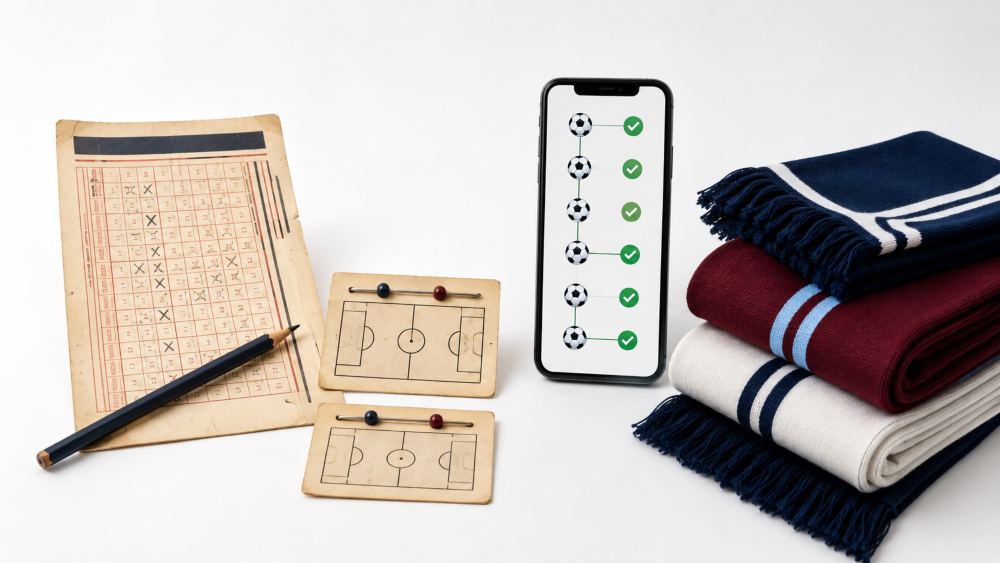
Here is the part that gets flattened whenever the pools are described as an early accumulator. They were close to the opposite.
Under the treble chance, you were not backing teams. You were hunting draws, with score draws counting for most, and the skill was entirely negative. You had to find the eight fixtures out of fifty where neither side would impose itself. You looked for evenly matched, tired, mid-table sides on heavy pitches. You were, in effect, predicting stalemate.
An accumulator inverts every part of that. It asks you to be right about a winner, then right again, then right again, with each leg depending on the one before it. The pools rewarded you for spotting where nothing decisive would happen. The acca punishes you for the single fixture where something decisive happens to the wrong team.
The emotional shape changes with it. A pools coupon failed quietly and all at once. An accumulator fails theatrically, usually at about twenty past four, usually because of a club you could not place on a map.
Five Men And The Winter Football Disappeared

The strongest evidence that the coupon had become a ritual rather than a pastime arrived in the winter of 1962 to 1963.
That season, the weather removed British football. The Met Office record of the country’s most severe winters describes blizzards, drifts and temperatures below minus twenty, colder than 1947 and the worst since 1740. Pitches were unplayable for weeks. FA Cup ties were postponed again and again.
The pools companies responded not by pausing but by inventing something. In January 1963 they convened a Pools Panel, a small group of former players and a former referee, who sat down and decided how matches that were never played would have finished. Their verdicts were announced publicly. A committee of five men imagined a football weekend into existence so that the coupons could still be settled.
It is a genuinely odd institution, and it belongs in the same cultural bracket as the artefacts held by the national collection of English football heritage. The ritual had become load-bearing. When the fixtures vanished, the country manufactured replacements rather than skip a week.
From The Doorstep Collector To The Phone Screen
The mechanics have changed more than the behaviour.
For decades, coupons moved by hand. Collectors walked routes, knocked on doors and gathered slips, which is why so many family memories of the pools involve a person rather than a shop. High street betting itself was a later arrival. Off-course cash betting was legalised by the Betting and Gaming Act 1960, and licensed offices opened from May 1961 with blacked-out windows and no seating, deliberately designed to be joyless.
The pools sat outside all of it. Parliament had already regulated them separately under the Pool Betting Act 1954, and the 1960 debates make clear that pool betting was intentionally left untouched by the new licensing regime. For a long stretch of the twentieth century, football prediction and betting-shop culture were two different worlds that happened to share a sport.
Digital collapsed the distance. Selections that once needed a week now take a few minutes, and the market depth available on a Tuesday afternoon would have looked absurd to a coupon-filler in 1968. Modern UK betting sites with dannybet.com sit at the end of that long process of compression, where the coupon, the fixture list and the results service all live on the same screen.
What survived the migration is the sequence. There is still a selection window. There is still the friend who will not touch an early kick-off. There is still someone backing a team everyone else has written off, and there is still the moment on Saturday afternoon when results start landing, and you check them against a list you made days earlier.
Social Life Of A Five Fold
Accumulators persist partly because they are a conversation format.
They give supporters something to disagree about that is not their own club. One person picks on form, another on team news, another on a hunch they cannot defend. Selections get screenshotted into group chats, argued over, revised when the line-ups appear and then held up as evidence for the rest of the season.
They also redistribute attention. A fixture in the third tier at the other end of the country means nothing on Friday and becomes the most important match of the weekend by Saturday teatime, purely because of where it sits in a chain. That is a peculiar way to end up watching football you would otherwise ignore, and it is one of the reasons the habit spreads across leagues rather than staying with a single club.
The scale is not marginal, either. The Gambling Commission’s official participation statistics for Great Britain recorded a clear majority of adults gambling in some form across twelve months, with a substantially smaller share once lottery-only players are removed. Coupon culture is a small part of a very large picture.
What The Multiplier Actually Does
The honest note belongs here rather than in a footnote, because the arithmetic is the whole point.
Every selection carries a built-in margin for the bookmaker. Combining selections does not average those margins out; it compounds them. A five-fold does not carry five times the excitement and the same cost. It carries the same excitement and a considerably worse expected return than any of its individual legs, which is precisely why accumulators are promoted so heavily and why the near-miss is such a familiar experience.
None of that makes the ritual illegitimate. It does mean the accumulator is best understood as a way of buying interest in a Saturday afternoon rather than a plausible route to money. Anyone who finds the habit stopped being fun can get free, confidential support through GambleAware, which is a more useful thing to know than any staking system.
A Format That Keeps Changing, A Habit That Does Not
Britain’s relationship with the football coupon has now outlived the paper it was printed on, the door-to-door collector, the treble chance and the classified results read aloud on a Saturday evening.
Printed coupons faded. Smartphones took the selection process from days to minutes. Live scores stopped being an event and became a background process. Supporters now hold more information before kick-off than a 1970s pools syndicate could have gathered in a season.
The underlying activity is unchanged. Someone looks at a fixture list, decides which results feel likelier than the odds suggest, commits to that opinion in front of other people and then spends an afternoon finding out. The coupon lasted because it never asked anyone to do anything new. It attached itself to something millions of people were doing regardless: watching football, arguing about football and guessing what happens next.
Disclaimer: This article is intended as cultural and historical commentary and is not betting advice. Gambling in Great Britain is restricted to adults aged 18 and over and should be treated as entertainment with money you can afford to lose, never as a source of income. Free and confidential support is available through GambleAware and the National Gambling Helpline.
References
- Littlewoods Heritage Project. Playing the Pools. National Museums Liverpool and partners. https://www.littlewoodsheritageproject.co.uk/playing-the-pools
- Centre for Intellectual Property and Information Law, University of Cambridge. Football League Ltd v Littlewoods Pools Ltd [1959] 1 Ch 637. CIPIL Virtual Museum. https://www.cipil.law.cam.ac.uk/virtual-museum/football-league-ltd-v-littlewoods-pools-ltd-1959-1-ch-637
- Met Office. Severe Winters: Case Studies. Met Office Learn About Weather. https://weather.metoffice.gov.uk/learn-about/weather/case-studies/severe-winters
- National Football Museum. Our Story. National Football Museum, Manchester. https://www.nationalfootballmuseum.com/our-story/
- UK Government. Betting and Gaming Act 1960 (8 & 9 Eliz. 2 c. 60), as enacted. legislation.gov.uk, The National Archives. https://www.legislation.gov.uk/ukpga/Eliz2/8-9/60/contents/enacted
- UK Parliament. Betting and Gaming Bill, House of Lords debate, 23 May 1960. Historic Hansard. https://api.parliament.uk/historic-hansard/lords/1960/may/23/betting-and-gaming-bill
- Gambling Commission. Gambling Survey for Great Britain, Annual Report 2024: Headline Statistics. Official statistics, produced with the National Centre for Social Research and the University of Glasgow. https://www.gamblingcommission.gov.uk/report/gambling-survey-for-great-britain-annual-report-2024-official-statistics/gsgb-annual-report-2024-headline-statistics
- GambleAware. Gambling Help and Support. GambleAware, Great Britain. https://www.gambleaware.org/
- FourFourTwo. How the ‘Big Freeze’ Decimated the Football Calendar During the 1962-63 Season. Consulted for detail on the formation of the Pools Panel in January 1963. https://www.fourfourtwo.com/news/how-big-freeze-decimated-football-calendar-during-1962-63-season