
Blog
Evolution Of Basketball Analytics And How Predictive Algorithms Are Changing Sports Forecasting

Basketball used to be discussed through points, rebounds, and who looked “hot” that night. Basic box scores still matter, but they miss too much. Teams now study shot charts, lineup patterns, and possession data because those numbers show where a game really shifted. Research on sports analytics reflects the same change, noting that statistics now shape both tactics and roster decisions.
Why Betting Spaces Followed The Same Data Logic
That change is easy to see in places where prediction matters. The same appetite for cleaner numbers appears in basketball coverage, trading rooms, sportsbook desks, and pages that track casino play, odds, and user guides, including an online casino resource built around games, payment systems, and practical information for players. The connection here is straightforward: once people get used to data-led decisions in one part of digital entertainment, they expect the same clarity everywhere else.

Basketball is a perfect case because it produces constant, measurable events. Every possession leaves a trace. Every possession leaves something concrete behind. A bad shot from the corner, a forced jumper with a hand in the face, or a late help defender all show up on film and in the numbers. That makes the sport unusually friendly to predictive work.
Numbers That Changed The Conversation
A modern basketball model rarely starts with raw totals. It starts with efficiency. Two players can finish with the same 24 points and still have completely different nights. One gets there within the flow of the offense, takes clean looks, and barely wastes a possession. The other needs far more shots, forces the pace, and puts extra pressure on the rest of the lineup. That is why teams look past the final total and dig into efficiency, shot map, tempo, turnovers, and lineup combinations. Those details show how the points were created and what they really cost.
Three tools changed everyday analysis more than most:
- Efficiency ratings that judge output per possession, not just per game.
- Shot charts that show where points come from and which areas are wasteful.
- Win probability models that estimate game state in real time.
These tools are useful because they answer ordinary questions people actually ask. Why did a team lose after leading by nine? Which five-person group survives late-game pressure? Why does one scorer look dominant on highlights but drag the offense across four quarters?
What Predictive Algorithms Actually Do
Predictive models do not guess mystically. They take past patterns, weight them, and estimate likely outcomes. A football example shows the logic well. The Habr piece breaks it down in a more grounded way. It shows how prediction models work from actual match data rather than gut feeling, and uses a Poisson-style approach to estimate likely outcomes from patterns in past scoring.
Basketball uses different event structures, but the logic is familiar. Instead of projecting total goals, a model may estimate possession value, expected shot quality, foul risk, or late-game scoring swings. The job is still the same: convert repeated patterns into better forecasts.
That is where shot charts and probability models become useful in the second half of the conversation, not just as technical jargon but as working tools. They help explain why one team’s offense looks smooth for three quarters and collapses once the shot profile changes.
Why This Matters To Fans As Much As Professionals
The smartest part of basketball analytics is not the math itself. It is the way it sharpens judgment. A fan watching a close fourth quarter can now understand more than momentum and nerves. A coach can see whether the weak-side help is late. An analyst can flag a lineup that gives up too many corner threes. A bettor or forecaster can stop treating every hot streak as meaningful.
One more detail matters here:
- Good models work best when they are tied to context.
- Recent form matters, but matchup structure matters too.
- Clean data helps, but clear interpretation helps more.
That is why forecasting in basketball keeps improving. The models are getting better, but so is the habit of asking better questions. And that habit tends to outlast any single trend line.
How Predictive Models Improve Forecast Accuracy
Predictive systems in basketball are not just about “guessing winners.” They break the game into measurable parts and assign probability values to each factor. This helps analysts understand why a prediction is made, not just the outcome.
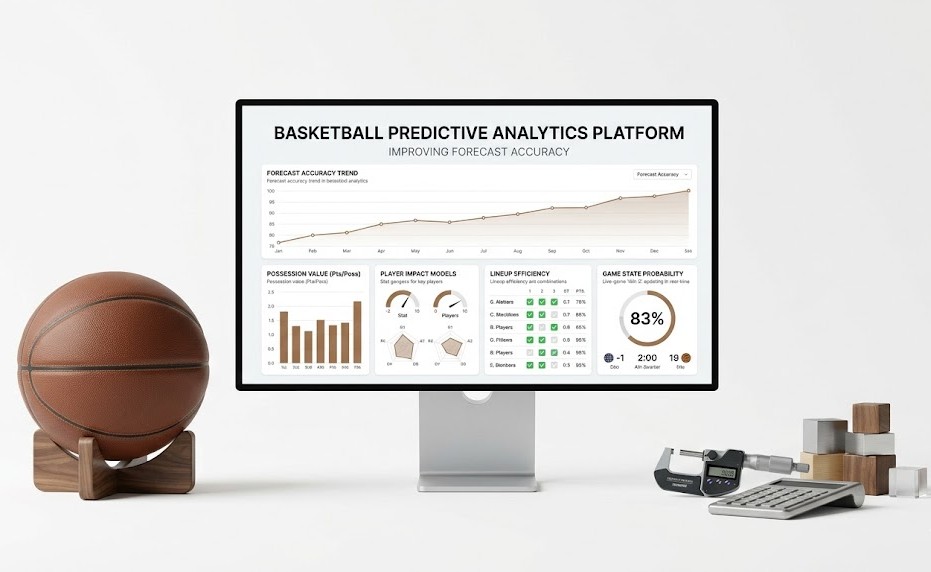
| Model Component | What It Measures | How It Improves Forecasting |
|---|---|---|
| Possession Value | Points expected per possession | Shows true offensive efficiency beyond scoring totals |
| Player Impact Models | Contribution of each player to team success | Identifies hidden influence beyond box score stats |
| Lineup Efficiency | Performance of different five-player combinations | Helps predict which rotations succeed or fail |
| Game State Probability | Likelihood of winning at different score/time situations | Improves live-game forecasting accuracy |
These models continuously adjust as new data comes in, making predictions more flexible and closer to real game conditions.
How Data Is Changing Coaching And Strategy Decisions
Analytics is no longer limited to forecasting; it actively shapes how teams play. Coaches now rely on predictive insights to decide rotations, matchups, and shot selection.
| Strategic Area | Traditional Approach | Data-Driven Approach |
|---|---|---|
| Lineup Selection | Based on experience and chemistry | Based on lineup efficiency and net rating |
| Shot Selection | Focus on mid-range and star players | Focus on high-efficiency zones (rim and 3PT) |
| Defensive Planning | Matchups and intuition | Opponent shot tendencies and tracking data |
| Late Game Strategy | Experience-based decisions | Win probability models and scenario simulations |
This shift means decisions are less emotional and more evidence-based, especially in high-pressure moments.
Final Conclusion
Basketball analytics has evolved from simple box score tracking into a complex system of predictive modeling and probability forecasting. What once relied on intuition and post-game summaries now depends on real-time data, efficiency metrics, and algorithmic predictions.
Predictive models don’t replace human judgment—they refine it. They help fans understand the game more deeply, assist coaches in making smarter decisions, and give analysts a clearer picture of performance beyond surface-level stats.
In short, basketball has become a sport where every possession tells a measurable story, and predictive algorithms help translate that story into future expectations.
Disclaimer
This content is for informational and educational purposes only. It does not provide betting advice, financial guidance, or guarantees of prediction accuracy. Sports outcomes are inherently uncertain, and all models and statistics should be interpreted as probability-based estimates, not certainties.
References
- Berri, D. J., & Schmidt, M. B. (2010). Stumbling on Wins: Two Economists Expose the Pitfalls on the Road to Victory in Professional Sports. Pearson Education.
- Silver, N. (2012). The Signal and the Noise: Why So Many Predictions Fail—but Some Don’t. Penguin Press.
- Kubatko, J., Oliver, D., Pelton, K., & Rosenbaum, D. T. (2007). A Starting Point for Analyzing Basketball Statistics. Journal of Quantitative Analysis in Sports, 3(3).
- Oliver, D. (2004). Basketball on Paper: Rules and Tools for Performance Analysis. Potomac Books.
- McKinsey & Company (2018). Sports analytics and the future of data-driven decision making in sports. McKinsey Insights Report.